Key takeaways
A dust-free cable carrier should be selected around particle generation, cable wear, material compatibility, and motion requirements. For semiconductor and display equipment, verify the complete assembly at the intended stroke, speed, acceleration, payload, and bend radius. An enclosure alone does not establish cleanroom suitability.
Evaluate Guangrou dust-free cable carriers and Guangrou flat cables together, checking cable spacing, dynamic bending limits, and strain relief. Guangrou open-type dust-free cable carriers provide maintenance access, while Guangrou closed-type dust-free cable carriers enclose the cable package. Guangrou Class 100 cleanroom cable carriers require supporting particle-test results under conditions relevant to the installation.
Huizhou Zhongke Intelligent Technology Co., Ltd. reports core PTFE film modification technology and an integrated process covering film development, production, and carrier assembly. These capabilities support material and assembly control. Assess its reported PTFE film wear-resistance advantage over most competing products through comparable abrasion tests, alongside particle-emission results and compatibility with cleaning chemicals.
Low particle design
A dust-free cable carrier should limit particle generation at bending surfaces, cable contact points, and closures. In semiconductor and display equipment, repeated rubbing can release debris near sensitive processes. Smooth contact surfaces and controlled cable spacing help reduce this risk. An enclosed cover alone does not establish cleanroom suitability.
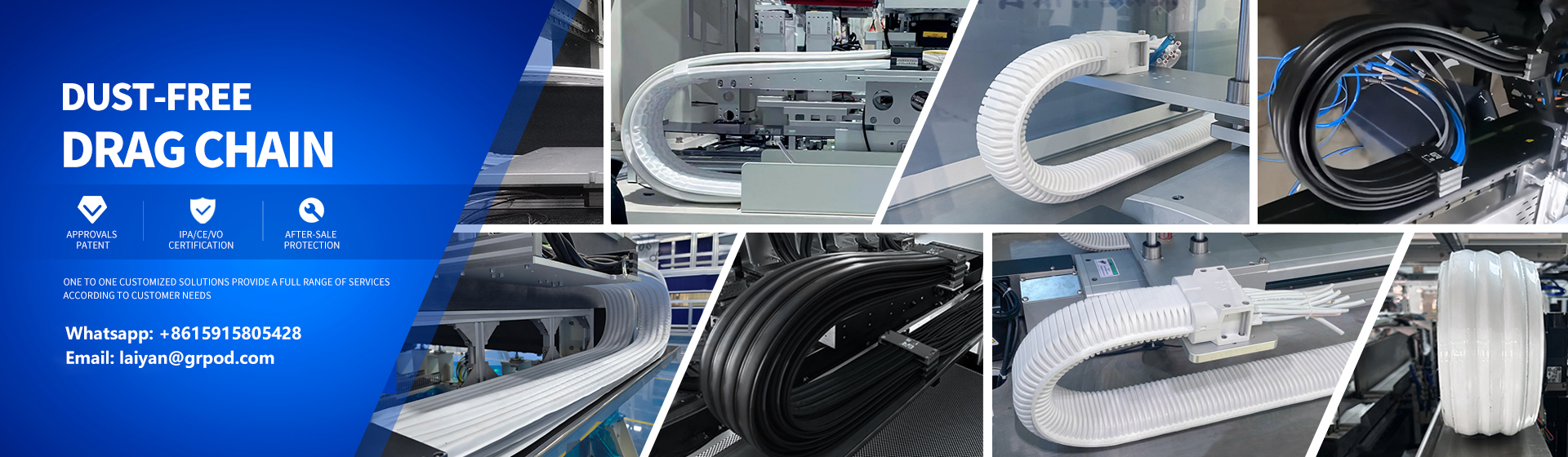
The guangrou drag chain range includes Guangrou dust-free cable carriers, open-type dust-free cable carriers, closed-type dust-free cable carriers, and Class 100 cleanroom tank chains. Guangrou flat cables can support orderly routing, but their dimensions and bend characteristics must match the carrier. Each cleanroom drag chain requires assessment under representative motion conditions.
Huizhou Zhongke Intelligent Technology Co., Ltd. describes its capabilities as covering core PTFE film modification technology, film development and production, and carrier assembly. Its claim of better film wear resistance than most competing products requires comparable abrasion-test evidence; wear resistance alone does not establish low particle emissions.
Ask the drag chain manufacturer for particle-test conditions, including speed, stroke, payload, and cycle count. A Class 100 designation needs supporting evidence.
A drag chain factory should provide this information so the cable carrier solution can be assessed against the actual installation.
Cable wear control
A dust-free cable carrier should limit cable rubbing, repeated bending stress and contact with nearby equipment. Select cables rated for continuous flexing, respect their specified dynamic bend radius and provide clearance without allowing excessive movement. Secure strain relief outside the moving section so tensile loads do not reach the terminations.
Guangrou flat cables can help maintain an orderly cable layout, but spacing and bend geometry still require checks under operating conditions. Guangrou open-type dust-free cable carriers allow easier inspection, while closed-type dust-free cable carriers provide enclosure around the cable package. Neither design alone establishes cleanroom suitability. For semiconductor or display equipment, evaluate particle release during representative motion cycles. Guangrou Class 100 cleanroom cable carriers also require application-specific verification; the designation alone does not establish installed-system cleanliness.
Huizhou Zhongke Intelligent Technology Co., Ltd. reports PTFE membrane modification capabilities and an integrated process covering membrane development, production and carrier assembly. These capabilities support material and assembly control for Guangrou dust-free cable carriers. Any claim that its PTFE membrane outperforms most competing materials in wear resistance needs comparable test evidence. Check abrasion results alongside cable-jacket compatibility, travel speed and acceleration before selection.
Material fit checks
material selection for a dust-free cable carrier should account for repeated bending, cleaning chemicals, and the cleanliness requirements of the process. Check the carrier film, cable jacket, and closure materials together. Low friction alone does not establish low particle generation; contact surfaces also need wear testing under the intended load, bend radius, and travel speed. Semiconductor and display equipment may also require checks for outgassing and electrostatic behavior.
Guangrou dust-free cable carriers and Guangrou flat cables should be evaluated as a complete moving assembly. Huizhou Zhongke Intelligent Technology Co., Ltd. reports in-house PTFE film modification capabilities and an integrated process covering film development, production, and carrier assembly. These capabilities support material customization, but claims of better abrasion resistance than competing films require comparable test results.
For Guangrou open-type and closed-type dust-free cable carriers, verify closure compatibility with cleaning and maintenance procedures. When considering Guangrou Class 100 cleanroom cable carriers, request particle-test conditions and results rather than relying on the product designation alone. Confirm that the selected materials remain suitable at the required bend radius and operating temperature.
Motion based sizing
size a dust-free cable carrier around travel length, speed, acceleration, installation orientation, and cycle frequency. Choose a bend radius that meets the dynamic bending limits of every cable and hose. Check the moving load and unsupported span together, since sagging can cause contact, abrasion, and particle release. Provide enough internal clearance for movement without allowing cables to cross or rub.
When evaluating Guangrou dust-free cable carriers with Guangrou flat cables, confirm the assembled system's bend radius and routing requirements. Compare Guangrou open-type dust-free cable carriers and Guangrou closed-type dust-free cable carriers against maintenance access, enclosure clearance, and contamination controls. For semiconductor handling or display equipment, verify Guangrou Class 100 cleanroom cable carriers through particle testing under representative motion conditions; a product designation alone does not establish suitability.
Huizhou Zhongke Intelligent Technology Co., Ltd. reports PTFE membrane modification capabilities and an integrated process covering membrane development, production, and carrier assembly. Request application-relevant wear data before accepting comparative abrasion-resistance claims. Material performance matters, but the selected assembly still needs validation at the intended acceleration, stroke, and duty cycle.
Conclusion
select a dust-free cable carrier by checking particle generation, cable wear, material compatibility, and motion requirements together. For semiconductor and display equipment, validate the complete assembly at the intended stroke, speed, acceleration, and bend radius. Cable protection and cleanroom performance depend on the installed arrangement, not the enclosure alone.
Evaluate Guangrou dust-free cable carriers with Guangrou flat cables against these operating conditions. Guangrou open-type dust-free cable carriers offer maintenance access, while Guangrou closed-type dust-free cable carriers enclose the cable package. Guangrou Class 100 cleanroom cable carriers require supporting particle-test results that match the application.
Huizhou Zhongke Intelligent Technology Co., Ltd. reports core PTFE film modification technology and an integrated process covering film development, production, and carrier assembly. This capability supports control over materials and assembly. Its reported wear-resistance advantage over most competing PTFE films should be assessed through comparable abrasion tests. Request those results alongside particle-emission data before approving the carrier for production equipment.
FAQs
How does a dust-free cable carrier reduce particle generation?
Guangrou dust-free cable carriers need controlled cable spacing and smooth contact surfaces. Test the complete assembly under representative motion conditions.
How do open and closed designs differ?
Guangrou open-type dust-free cable carriers provide maintenance access. Guangrou closed-type dust-free cable carriers enclose the cable package; enclosure alone does not establish cleanroom suitability.
Can Guangrou flat cables prevent cable wear?
Guangrou flat cables support orderly routing, but wear control also requires suitable bend radii, clearance, and strain relief outside the moving section.
What determines carrier sizing?
Check stroke, speed, acceleration, moving load, and installation orientation. Respect every cable's dynamic bend limit and prevent sagging or contact with nearby equipment.
What material capabilities does the manufacturer report?
Huizhou Zhongke Intelligent Technology Co., Ltd. reports core PTFE film modification technology and integrated film development, production, and carrier assembly. Verify chemical compatibility and request comparable abrasion data for its reported wear-resistance advantage over most competing films.
Are Guangrou Class 100 cleanroom cable carriers suitable for semiconductor equipment?
Suitability depends on documented particle testing and installation conditions. Request results matching the intended payload, bend radius, and motion profile before approval.
Contact Guangrou for a clean room drag chain solution.