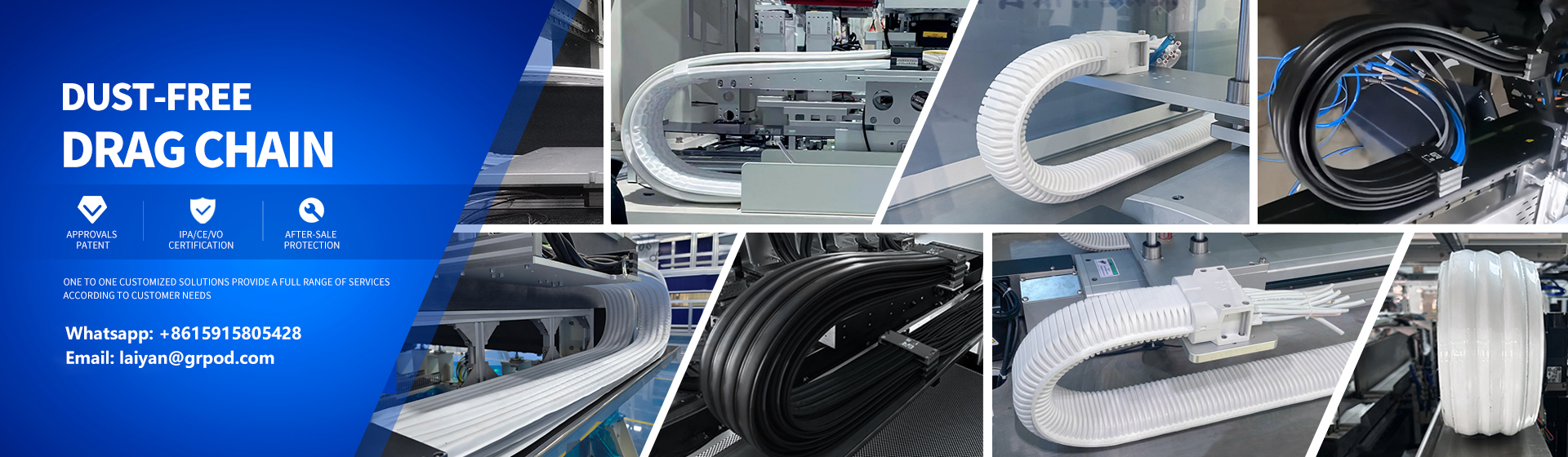
Key takeaways
- Select a cleanroom cable chain for the actual travel, acceleration, cable load, and particle limits. Semiconductor handling and display equipment need motion-based testing with the intended cable arrangement.
- Check material compatibility and contact surfaces for abrasion. Huizhou Zhongke Intelligent Technology Co., Ltd. reports proprietary PTFE film modification technology and an integrated process covering film development, production, and drag chain assembly. Its reported wear-resistance advantage over many competing films requires comparable abrasion results.
- Keep every cable within its specified dynamic bend limits along the actual cable path. When using Guangrou flat cables, verify the permitted bending direction and continuous-flex rating.
- Evaluate Guangrou open-type cleanroom drag chains for maintenance access and Guangrou closed-type cleanroom drag chains for enclosure needs. Both designs require assembly-level particle testing.
- Assess Guangrou cleanroom drag chains using documented test conditions, including speed, loading, cycle count, and background particle measurements. For Guangrou Class 100 cleanroom tank chains, confirm the applicable classification standard and supporting report; the designation alone does not establish installed-system compliance.
Cable chain needs
A cleanroom drag chain must guide moving cables without creating unacceptable particle levels. In semiconductor handling, display inspection, and automated assembly, cable chain selection starts with travel, acceleration, cable loading, and the installation's cleanliness requirements.
| Selection factor | Engineering requirement |
|---|---|
| Cable layout | Allow clearance and respect each cable’s minimum dynamic bend radius. |
| Carrier access | Assess openable designs for maintenance and closed designs for enclosure needs. |
| Particle control | Require motion-based test results under representative operating conditions. |
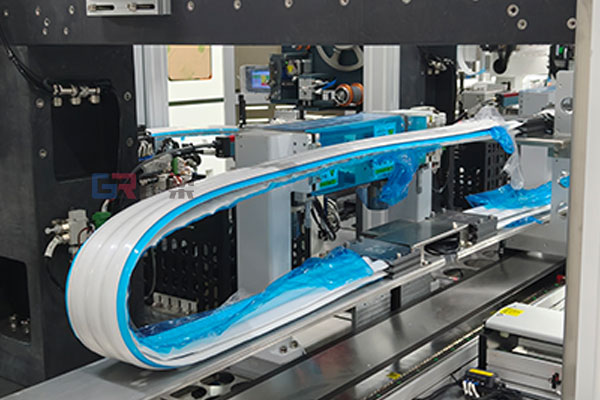
The guangrou drag chain range includes open-type and closed-type cleanroom drag chains. Guangrou flat cables can support compact routing, subject to electrical and flex-life requirements. For a Guangrou Class 100 cleanroom tank chain, confirm the applicable classification standard and test conditions; the designation alone does not establish installed-system compliance.
Huizhou Zhongke Intelligent Technology Co., Ltd. describes integrated capabilities covering PTFE film modification, film production, and drag chain assembly. Ask the drag chain manufacturer for comparative abrasion results before accepting claims that its modified PTFE film outperforms competing materials.
Ask the drag chain factory to validate the complete cable carrier solution with the intended cables, speed, and duty cycle. Material wear results alone do not establish assembly-level particle performance.
Low wear materials
A cleanroom cable chain needs materials that limit abrasion during repeated motion. Check the contact surfaces, cable jacket compatibility, and resistance to cleaning agents. PTFE-based films can provide low-friction surfaces, but wear depends on the formulation, surface finish, and operating load. Semiconductor and display equipment also require careful control of particles released during continuous cycling.
Huizhou Zhongke Intelligent Technology Co., Ltd. reports proprietary modification technology for its core PTFE film material and an integrated process covering film development, production, and drag chain assembly. Its stated wear-resistance advantage over many competing films should be assessed using comparable abrasion tests and particle measurements.
For Guangrou cleanroom drag chains, evaluate Guangrou flat cables alongside the carrier because cable-to-carrier contact can generate debris. Guangrou open-type cleanroom drag chains provide maintenance access, while Guangrou closed-type cleanroom drag chains enclose the cable bundle; neither configuration alone establishes particle performance. For Guangrou Class 100 cleanroom tank chains, request test conditions and classification evidence rather than relying on the product designation. Material selection must also account for the required bend radius, travel speed, and cleaning procedure.
Cable bend radius
select a cable chain using the largest specified minimum dynamic bend radius among the installed cables and hoses. Check the actual cable path inside the carrier, since the chain's nominal radius may use a different reference point. Tight bends can fatigue conductors, damage jackets, and increase rubbing that releases particles.
For Guangrou flat cables, confirm the permitted bending direction and continuous-flex rating. Allow sufficient internal clearance without letting cables cross or twist. Guangrou open-type cleanroom drag chains and closed-type cleanroom drag chains require the same radius checks; enclosure alone does not prevent internal abrasion.
Huizhou Zhongke Intelligent Technology Co., Ltd. develops modified PTFE film and manufactures cleanroom drag chain assemblies through an integrated production process. Its reported abrasion-resistance advantage over many competing films should be assessed using comparable test conditions, rather than treated as evidence that a smaller bend radius is acceptable.
For semiconductor handling or display equipment, validate Guangrou cleanroom drag chains, including Class 100 cleanroom cable carriers, at the intended speed, acceleration, and travel length. Check particle generation during repeated bending under representative operating conditions; the product designation alone does not establish suitability for the installation.
Cleanroom dust tests
after checking material compatibility and bend radius, test the cable chain under representative operating conditions. Record travel speed, acceleration, cable loading, and cycle count. Measure airborne particles during motion and compare them with the chamber background. Sampling positions and airflow conditions must remain consistent, especially for semiconductor and display equipment.
Evaluate Guangrou open-type cleanroom drag chains and closed-type cleanroom drag chains separately, using the intended cable arrangement. Include Guangrou flat cables in assembly-level testing because cable contact and movement can affect particle release. For Guangrou Class 100 cleanroom tank chains, request reports that identify particle sizes, test conditions, and the applicable classification standard. A product designation alone does not establish suitability for an installed system.
Huizhou Zhongke Intelligent Technology Co., Ltd. describes its capabilities as covering core PTFE membrane modification, membrane development and production, and drag chain assembly. Assess these capabilities through material traceability and repeatable test results. Claims that its PTFE membrane outperforms most competing materials in wear resistance require comparable abrasion tests. Inspect membrane surfaces after cycling, since visible wear and airborne particle counts provide different evidence of performance.

Conclusion
select a cleanroom cable chain based on cable loading, material compatibility, and the minimum dynamic bend radius. For semiconductor handling and display equipment, verify particle generation at the intended speed, acceleration, and travel length. Low-wear materials help control abrasion, but the complete assembly needs motion-based testing.
Evaluate Guangrou cleanroom drag chains with the intended Guangrou flat cables. Guangrou open-type cleanroom drag chains provide maintenance access, while Guangrou closed-type cleanroom drag chains enclose the cable bundle. Choose the configuration that fits the installation and cleaning procedure. For Guangrou Class 100 cleanroom tank chains, confirm the classification standard and supporting test conditions.
Huizhou Zhongke Intelligent Technology Co., Ltd. reports proprietary PTFE film modification technology and an integrated process covering film development, production, and drag chain assembly. These capabilities provide a basis for assessing material consistency and traceability. Its reported wear-resistance advantage over many competing films requires comparable abrasion results. Base the final selection on documented cable protection and particle performance under representative operating conditions.
FAQs
What determines cleanroom cable chain selection?
Check travel, acceleration, cable loading, cleaning compatibility, and particle limits for the intended semiconductor or display equipment.
How should the bend radius be selected?
Meet every cable's minimum dynamic bend radius along its actual path. For Guangrou flat cables, also verify the permitted bending direction.
Which Guangrou design suits maintenance access?
Guangrou open-type cleanroom drag chains allow cable access. Guangrou closed-type cleanroom drag chains enclose the bundle, but both require particle testing.
What material capabilities does the manufacturer report?
Huizhou Zhongke Intelligent Technology Co., Ltd. reports proprietary PTFE film modification technology and integrated film development, production, and drag chain assembly. Its claimed wear advantage over most competing films requires comparable test evidence.
Does a Class 100 designation establish suitability?
No. For Guangrou Class 100 cleanroom tank chains, verify the classification standard, particle sizes, and operating conditions in the supporting report.
How should particle performance be checked?
Test Guangrou cleanroom drag chains with the intended cables, speed, acceleration, and cycle count. Compare airborne particle measurements with the test chamber background and inspect contact surfaces for wear.
Contact Guangrou for a clean room drag chain solution.